Light around us
Light helps us see everything around us. Without light, the world would be dark and we would not be able to see people, objects, or colours.
Light is very important in our everyday lives. It helps us:
- see where we are going
- read books
- play games
- stay safe when it is dark
Some things make their own light. These are called sources of light.
Sources of Light
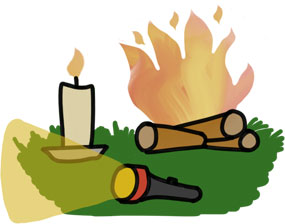 A source of light is something that gives off light all by itself.
Examples of light sources include:
- the Sun
- lamps and lights
- torches
- candles
- fire
The Sun is a natural light source. This means it comes from nature and is not made by people. The Sun is the biggest and brightest light source for Earth.
Artificial light sources are made by people to help us see when it is dark. Lamps, lights, and torches are artificial light sources. We use them in our homes, schools, and streets.
Sources of light
- Gather a few objects together.
- Turn the lights off in the room and see if any of the objecst give off their own light.
Notice how shiny objects, such as a mirror or a shiny spoon, do not give off light. This means that you won't be able to see in the dark with those objects. These objects are reflective, and they simply reflect the light.
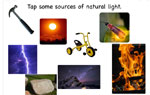 Sources of Light
Identify sources of light, natural and man-made. Identify lights that help us and lights that are fun.
Light and dark
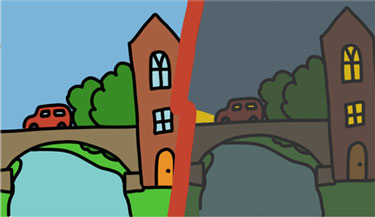 Light helps us see the world around us. When there is plenty of light, we can see objects clearly, including their shape, size, and colour.
Dark is when there is little or no light. In the dark, it is hard or even impossible to see things properly.
During the daytime, the Sun lights up the Earth, so it is bright outside. At night, it becomes dark because the Sun is no longer in our part of the sky.
When it is dark, we use artificial lights to help us see, such as:
- lamps
- ceiling lights
- torches
- street lights
These lights help us move around safely and see what we are doing.
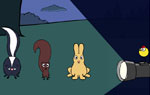 Night Light
See how objects in a dark space can only be seen when light shines with a torch. Spot all the animals in the forest.
Loud and quiet sounds
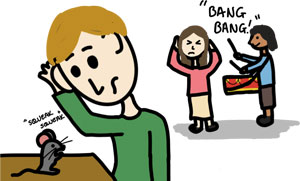 Not all sounds are the same. Some sounds are loud, and some sounds are quiet.
- A sound is usually louder when it is close to us
- A sound becomes quieter as it moves farther away
For example, a fire engine sounds very loud when it is nearby, but much quieter when it is far down the road.
We should always protect our ears from very loud sounds because loud noises can hurt them.
Also on Super Brainy Beans