Skeletons and movement
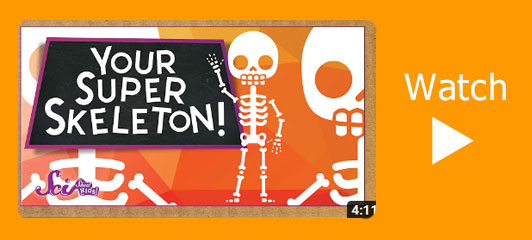
Your body is like a clever machine, and inside, there’s a strong frame called the skeleton.
Your bones make up your skeleton. They give your body shape and support, helping you to stand, sit and move. Without bones, you’d be like jelly!
Bones also protect important organs in your body. Some bones have very special jobs:
- Skull – Protects your brain like a hard helmet.
- Rib cage – Protects your heart and lungs.
- Spine – Supports your body and helps you bend and twist.
An adult human has 206 bones in their body.
 Skeleton & Bones
Learn about moving & growing by sorting and labelling the bones from skeletons of things such as an insect, fish, horse or human.
Why do we need water?
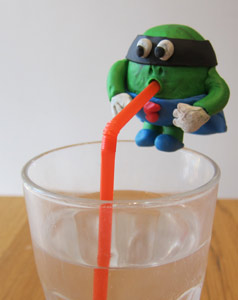 Water is extremely important. In fact, more than half of your body is made of water.
We need water to:
- Move nutrients around the body
- Control body temperature (so we do not overheat)
- Help our brain work properly
- Keep us alert and focused
- Remove waste from the body
If we do not drink enough water, we can become dehydrated. When this happens, we might feel:
- Tired
- Grumpy
- Dizzy
- Too hot
- Unable to concentrate
Drinking water regularly throughout the day helps keep your body working at its best.
How much water do I need?
| Age | Glasses of water |
| 5-8 years old | 5 glasses |
| 9-12 years old | 7 glasses |
| 13+ years old | 8-10 glasses |
Why do we need exercise?
Exercise keeps your body strong and healthy.
When you exercise, your heart beats faster. This is a good sign — it means your heart and lungs are working hard and becoming stronger. Strong muscles, a healthy heart and powerful lungs help you stay active and energetic.
Exercise also:
- Improves concentration
- Helps you sleep better
- Boosts your mood
- Gives you more energy
Have you ever run around so much that you could feel your heart beating quickly afterwards? That means your heart has had a good workout!
How much exercise do I need?
Children aged 5–8 should aim to do at least one hour of physical activity each day.
You know you are working hard enough if:
- Your heart is beating faster
- You feel warm
- You may start to sweat
Activities can include running, cycling, dancing, swimming or playing sports. It all counts!
Keeping active every day helps keep your body in tip-top condition.
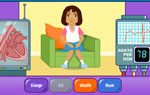 Keeping Healthy
Learn how to keep yourself healthy by discovering how different exercises such as walking and running can affect your heart rate.
Nutrition and a balanced diet
To keep our bodies working properly, it is important to live a healthy lifestyle. One of the best ways to do this is by eating a balanced diet and drinking plenty of water. Our bodies cannot make their own food like plants can. We need to eat food to get nutrients, substances that give us energy, help us grow and keep our bodies healthy. A balanced diet means eating the right amounts of different types of food.
There are five main food groups. Each group has an important job:
- Fruit and vegetables – These are full of vitamins and minerals that help us stay healthy and fight illness.
- Carbohydrates – Foods like bread, rice, pasta and potatoes give us energy to move, learn and play.
- Proteins – Meat, fish, eggs, beans and nuts help our bodies grow and repair themselves.
- Dairy – Milk, cheese and yoghurt help keep our bones and teeth strong because they contain calcium.
- Fats and sugars – These give us energy, but we only need a small amount. Too much sugar can harm our teeth and affect our health.
Eating a mix of these foods helps our bodies stay healthy, active, and ready to learn!
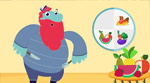 What is a balanced diet?
The human body needs a balanced diet to work properly.
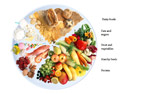 DK Find out!
What you need in a balanced diet, dairy, fats & sugars, fruit & vegetables.
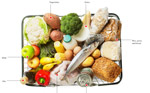 DK Find out!
What's in food? Learn about nutrients in the foods we eat.
What are fruit and vegetables?
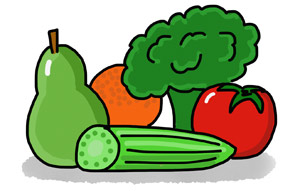 Fruit and vegetables gives us our vitamins and minerals. The vitamins and minerals do all sorts of things for our bodies. They help build strong bones and teeth, keep our body fighting off germs and help heal wounds.
Fruits include: apple, banana, orange, grapes, strawberries
Vegetables include: carrots, broccoli, peas, cucumber, sweetcorn
One third of what we eat a day should be fruit and vegetables. A great way to measure this is to eat 5 handfuls of fruit or vegetables. Try it. How many handfuls of fruit and vegetables are you eating every day?

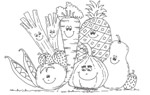 Fruit & Veg colouring in
Fruit & Veg colouring in sheets and guessing game for you to print and play
What are carbohydrates?
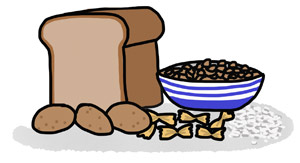 Carbohydrates are foods that give us energy. The type of foods that give us energy are bread, potatoes, pasta, rice, cereals, cakes and biscuits.
Starches and sugars
Carbohydrates are split into two groups, starches and sugars. Starches are the ones that really give us our energy. Bread, potatoes, pasta, rice and cereals. One third of what we eat every day should be of starchy foods.
Biscuits and cakes are carbohydrates but they contain sugars. Your body only needs very little of these.
 What are carbohydrates?
Bread, cereals, pasta, rice, and sweet foods are mostley carbohydrates.
What are proteins?
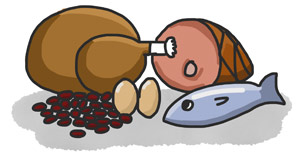 Our body needs proteins to grow and repair itself. Proteins help protect you from getting ill and is what your muscles, organs, hair and skin are made of.
Some of the types of foods that give us protein are chicken, ham, beef and fish. If you do not eat meat then you can find protein in beans, nuts, seeds, eggs, lentils and beans.
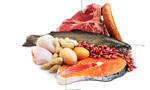 What is protein?
Foods such as meat, fish, eggs, beans and nuts all contain protein.
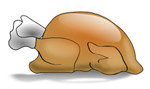 Food facts
What foods are high in proteins? How do proteins work in our bodies?
What is dairy?
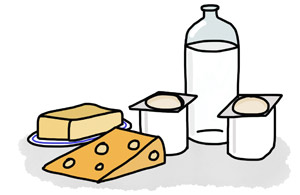 Dairy foods come from milk and are important for keeping our bodies strong and healthy. They give us calcium, which helps build strong bones and teeth. Dairy foods also contain protein, which helps our bodies grow and repair themselves.
Common dairy foods include milk, cheese, and yogurt. These can be eaten at breakfast, lunch, or as a snack. Some people drink plant-based alternatives like soya or oat milk – these can be healthy too if they have added calcium.
What are sugar and fats?
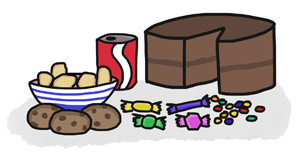 Sugar can be found in a lot of foods that we like the taste of but they are not necessarily good for us. Sweets, chocolate, honey, cakes and biscuits all contain too much sugar and we shouldn't eat too much of this everyday. Having too much sugar can be harmful to your teeth and cause tooth decay. Eating too much sugar can also cause you to put on weight which is bad for your health and can cause things like diabetes and heart disease.
Fats give our body energy that is stored as a fat layer under the skin to keep us warm. Too much fat will cause a bigger layer under the skin and will cause us to look bigger than we should be. Fats can also build up in your arteries, the tubes that carry your blood around your body. When this happens your brain and heart doesn't always get the amount a blood flowing that it needs and this can cause problems with your health.
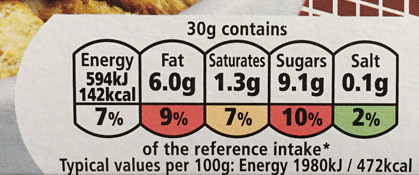 Foods that have fats are butter, oil, cream, mayonnaise, ice cream, crisps, cakes and biscuits. In fact most food have some kind of fat. The here is a food label from a cereal box. Even though we know that cereal is a carbohydrate is still contains fat.
Saturated and unsaturated fats
It's good to have a little bit of fat in what you eat and unsaturated fat is the better to have. Saturated fat is not good for our bodies and you can find saturated fat in many foods such as butter, cheese, ice cream, biscuits and cakes. Check out the food label again. It has 6.0g of fat in this cereal. 1.3g of that is saturated fat. Check your food labels at home, how much saturated fat does your food have?
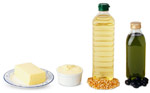 What is fat?
Nuts and dairy foods, such as butter and cheese contain fat.
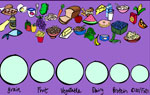 Food Group Sorter
Sort the foods into the right food groups. Are they grain, fruit, vegetable, dairy, protein or fats?

Teeth and dental health
We use our teeth every day to bite, chew and help us speak clearly. Humans have different types of teeth, and each type has a special job.
Types of teeth
- Incisors - These are the sharp teeth at the front of your mouth. They help you bite into food, like when you take a bite of an apple.
- Canines - These are the pointed teeth next to your incisors — one in each corner of your mouth. They are used for tearing food.
- Premolars and Molars - These are the larger teeth at the back of your mouth. They have flatter surfaces that help grind and crush food into smaller pieces so it is easier to swallow and digest.
All of these teeth work together to help your digestive system do its job properly.
Most children have 20 baby teeth, which are later replaced by 32 adult teeth.
Looking after your teeth
Brushing your teeth twice a day helps prevent tooth decay. Dentists recommend brushing for two minutes each time.
Too much sugar can cause a sticky layer called plaque to build up on your teeth. Plaque contains bacteria that turn sugar into acid. This acid can damage the enamel (the hard outer layer of your teeth) and cause cavities.
To keep your teeth healthy:
- Brush twice a day with fluoride toothpaste
- Avoid too many sugary foods and drinks
- Visit the dentist regularly
How well do you brush your teeth?
You can buy special disclosing tablets from a pharmacy. These colour any plaque left on your teeth, helping you see how well you have brushed.
- Brush your teeth carefully for two minutes using a timer.
- Apply the tablets (read the instructions)
- Take a look at your teeth.
- Are there any areas you missed?
Important: Always follow the instructions on the packet carefully.
 Teeth are used for..
Find out about the different ways we use our teeth.
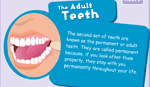 Types of teeth
Learn about the different kinds of teeth in your mouth, and what they're used for.
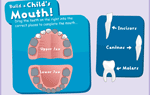 Build a mouth
Learn where in the mouth the different teeth are found.
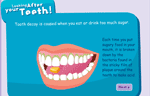 Looking after your teeth
Find out how you can keep your teeth and gums healthy for life!
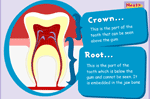 Structure of a tooth
Learn about the different materials that make up your teeth.
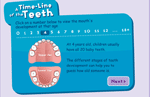 Teeth Timeline
Learn when the different kinds of teeth will emerge.
Also on Super Brainy Beans