Why we need light
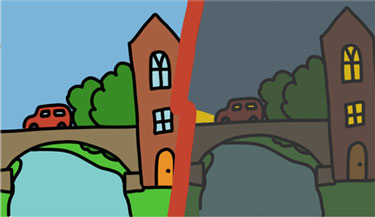 We need light to see the world around us. Without light, everything would be dark because darkness is the absence of light.
We can see objects because light:
- comes directly from a light source, or
- reflects off objects and travels into our eyes
Light sources give out their own light. Examples include:
- the Sun
- stars
- flames (like candles or fires)
- light bulbs and lamps
When light hits an object, it bounces off the surface and enters our eyes. This helps us see the object’s shape, colour, and position.
Shadows
Light travels in straight lines and cannot bend around objects. When a solid object blocks the light, it creates a shadow.
A shadow is a dark area where light cannot reach.
Shadows:
- appear on the opposite side of the light source
- have the same shape as the object making them
- are formed when light is blocked by a solid object
Changing shadow size
The size of a shadow depends on how close the object is to the light source:
- When the object is close to the light source, the shadow is large
- When the object is far away, the shadow is smaller
The position of the light source also affects where the shadow appears.
Make your own shadow
- Turn on the torch or lamp.
- Hold your hand in front of the light to make a shadow.
- Move your hand closer to the light.
- Move your hand further away.
- What do you notice? How does the shadow change size? Does the shape of the shadow change?
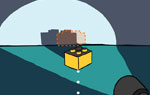 Shadow shapes
Move the object forward or back to match the shape of the shadow.
How sounds are made
Sound is made when something vibrates. A vibration is a quick back-and-forth movement.
When an object vibrates, it makes the air around it vibrate too. These vibrations travel through the air as sound waves. When the sound waves reach your ear, they make your eardrum vibrate, and your brain understands this as sound.
Examples of vibrating objects:
- Guitar strings vibrate when they are plucked
- Drum skins vibrate when they are hit
- Vocal cords vibrate when we talk, sing, or shout
If something is not vibrating, it cannot make a sound.
Make your own instrument
- Tie the elastic bands around an open box.
- Try plucking the bands.
- How do they sound? Did you notice that the small elastic bands have a different pitch to the large ones?
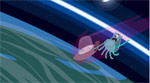 How are sounds made?
Sounds are made when objects vibrate. The vibrations enter your ear and you hear them as sound. Find out more about how sound travels.
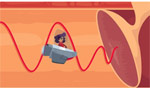 How are sounds detected?
Sound waves make the eardrum vibrate and then send messages to the brain. Find out more about how the ear detects sounds.
Loudness and pitch
Sounds can be different in how loud or quiet they are, and how high or low they sound. These differences are caused by vibrations.
Loud and quiet sounds depend on the size of the vibration:
- Large vibrations make loud sounds
- Small vibrations make quiet sounds
For example, hitting a drum hard makes a louder sound than tapping it gently.
Pitch tells us whether a sound is high or low. Pitch depends on how fast something vibrates:
- Fast vibrations make a high-pitched sound
- Slow vibrations make a low-pitched sound
Short or thin strings vibrate faster and make high-pitched sounds. Long or thick strings vibrate more slowly and make low-pitched sounds.
Volume tells us how loud or quiet a sound is. Louder sounds are made when vibrations are stronger, and quieter sounds are made when vibrations are weaker.
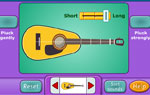 Changing Sounds
Learn about changing sounds as you experiment with different musical instruments. Plucking strings of different lengths results in a variety of sounds.
 What is a pitch?
A drum with a tight skin makes a high pitched wave. Find out more about sound waves and pitch.
 What is the volume of sound?
Sounds are vibrations that travel through the air. A weak vibration doesn't travel very far. Discover more about volume.


Also on Super Brainy Beans