
Times Tables
In Year 1 & 2 you should learn the 2 times table, 5 times table and 10 times table. Knowing these by heart will help you solve math problems much faster as you move up through school.

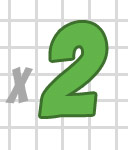
Counting in groups
Before you start multiplying with symbols, practice skip counting out loud. This means counting up from zero in steps of 2s, 5s, or 10s instead of 1s. It helps your brain get used to the patterns and rhythm of the times tables.
Let's count in 2s up to 20:
2, 4, 6, 8, 10, 12, 14, 16, 18, 20
Working out multiplication sums
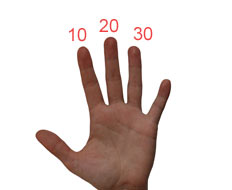 To work out a multiplication sum first find the number you can count in.
10 x 3
Lets count in tens as this is the easiest. Now count in tens using three fingers on your hand. What have we got to?
Yes, the answer is 30.
10 x 3 = 30
 Multiplication.com
Use these games to practice your times table skills.
 Fun 4 the brain
Use these games to practice your multiplication skills.

Using multiplication boxes
Multiplication boxes are like drawing a row of little present boxes to help you see a maths sum! You draw one long box, cut it into equal parts, and put the same number inside each part.
5 x 3

- Draw a long box.
- Split it into 3 parts.
- Write the number 5 inside each part.
- Now count in fives. 5, 10, 15.
- The total for all the boxes is 15 .
5 x 3 = 15
Practice using multiplication boxes (Singapore bar method) to work out these sums.
Making arrays with objects
When you first start multiplying, it helps to use real objects like blocks, buttons, or counters. You can arrange them into neat, even rows and columns. In maths, this grid of objects is called an array (say a-ray).
Looking at an array helps you see how equal groups fit together.
To show 2 x 4, you can make or draw 2 rows with 4 dots in each row.

Count them up: 4 + 4 = 8
Practice using multiplication arrays to work out these multiplication sums.
Jumping on a number line
A number line is a brilliant tool to help you see a maths sum. Multiplication is just making equal-sized jumps along the line to reach a bigger number.
2 x 5 can be drawn on a number line in 5 jumps of 2.
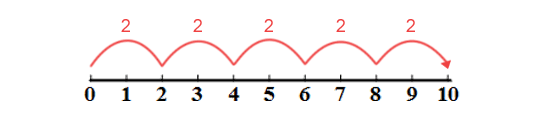
Write out the multiplication sum by using a number line.
Also on Super Brainy Beans