Decimal money
Money is usually written as a decimal number using pounds and pence.

When writing money, the decimal point separates pounds from pence.
For example:
- £1.05 = 1 pound and 5 pence
- £2.50 = 2 pounds and 50 pence
- £7.75 = 7 pounds and 75 pence
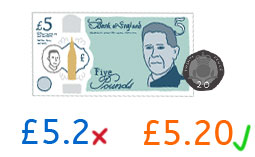
Notice that money is always written with two digits after the decimal point.
Adding money
Working out how much a number of items cost together is useful, especially when you have a limit on how much you can spend.
As the numbers become larger, it is often helpful to use column addition. Remember to always line up the decimal points carefully.
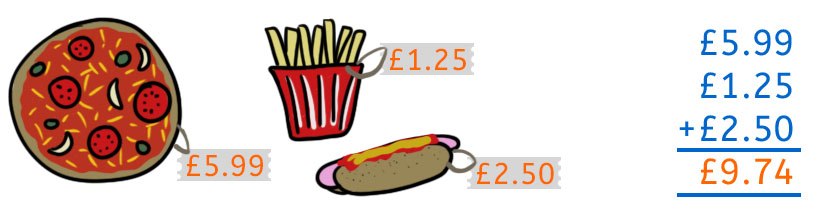
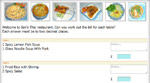 Sak's Thai Restaurant
Welcome to Sak's Thai restaurant. Can you work out the bill for each table? Each answer must be to two decimal places.
Subtracting money
Subtracting money helps us find differences and calculate change.
£15.00 - £8.75 = £6.25
The difference between the two amounts is £6.25.
Calculating change
If you know the cost of an item and the amount paid, you can work out the change.
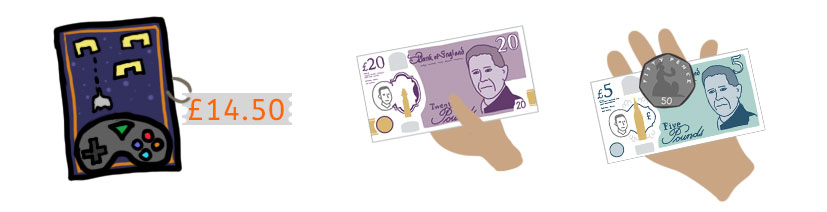
A game costs £14.50. You pay with £20. £20.00 − £14.50 = £5.50. The change is £5.50.
Always check your answer to make sure it is reasonable.
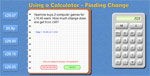 Finding Change
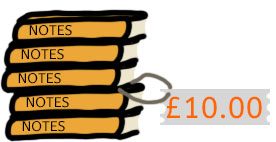
Use a calculator to work out the change for the question on the note pad.
Multiplying money
Multiplication is useful when buying several items that cost the same amount.
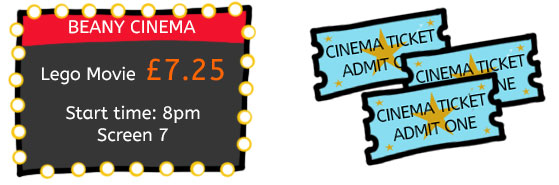
Cinema tickets cost £7.25 each. 3 tickets: £7.25 × 3 = £21.75
£7.25 x 3 = £21.75
Multiplication helps you quickly calculate the total cost of multiple purchases.
Budgets
A budget is a plan for how much money you can spend.
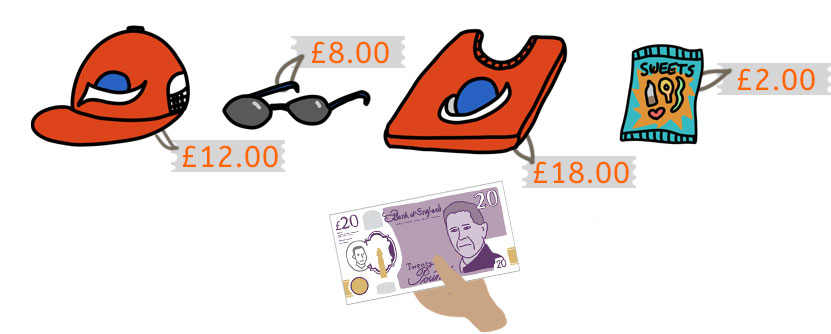
Imagine you have a budget of £20. If you spend £12.00, you need to work out how much money remains.
£20.00 - £12.00 = £8.00
You still have £8.00 left to spend.
A budget helps you decide what you can afford. Before buying something, ask:
- Do I have enough money?
- Will I stay within my budget?
- Is there a cheaper option?
 Price lists
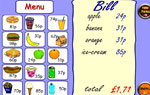
Decide what you can buy for 10p, 20p or 50p. See the items displayed in a list. Select one of the three games at the bottom of the screen.
 The Budget Game
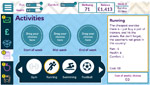
Manage your money for three months. Get it right and your happiness will soar, but spend too much and you'll have a financial headache!
Comparing prices
Comparing prices helps you make smart choices when shopping.
Sometimes two products look similar but cost different amounts. Compare prices carefully to see which offers better value.
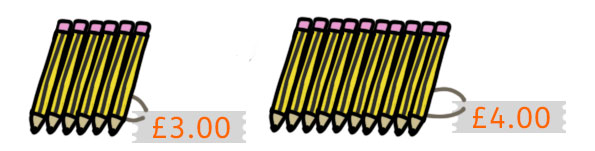
Pack A: 6 pencils for £3
Pack B: 10 pencils for £4
Although Pack B costs more, it may offer better value because you get more pencils for your money.
Comparing prices helps you choose the best deal.
 Money - two-step problems
Challenge yourself with money-related questions with two-step problems.

Also on Super Brainy Beans