
Money Year 3 & 4
Money Year 3 & 4, KS2. Primary homework help with Maths. Learn to count money, add and subtract, estimate and solve money problems.
Pick a level
Counting pounds and pence
Money is often written using pounds (£) and pence (p).

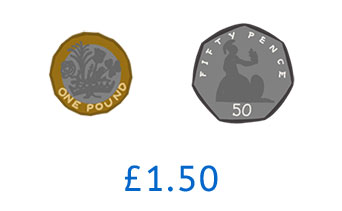
£1.50 means 1 pound and 50 pence.
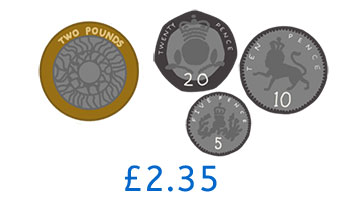
£2.35 means 2 pounds and 35 pence.
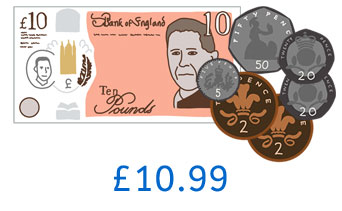
£10.99 means 10 pounds and 99 pence.
When reading money, the numbers after the decimal point show the number of pence.
£2.61 = 2 pounds and 61 pence
Being able to read amounts correctly is important when shopping and comparing prices.
Comparing and ordering money
Sometimes we need to compare different amounts of money.
When comparing money, look at the number of pounds first. If the pounds are the same, compare the pence.
£4.50 is greater than £4.20
You can also put amounts in order from smallest to largest or largest to smallest.
£1.25, £2.10, £2.50, £3.00
The smallest amount is £1.25 and the largest amount is £3.00.
Practising ordering amounts helps you become more confident when working with money.
Adding money
Adding money helps us find the total cost of several items.
When adding money, add the pounds and pence together carefully.
£2.50 + £1.25 = £3.75
You can use column addition to help when the numbers become larger.
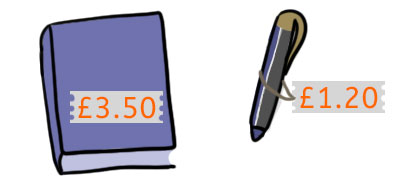
Imagine you buy:

To find the total cost, add the prices together.

Add money is a useful skill whenever you buy more than one item.
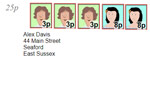
Stamp StickingDrag the stamps onto the envelopes to make the exact postage as shown at the top left of each envelope.
Subtracting money
Subtracting money helps us find the difference between amounts.
£5.00 - £2.50 = £2.50
The difference between £5.00 and £2.50 is £2.50.
Calculating change
If you know how much an item costs and how much money was given, you can work out the change.
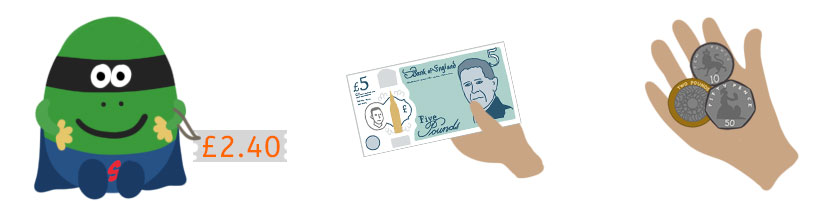
A toy costs £2.40. You pay with £5.00. £5.00 − £2.40 = £2.60. The change is £2.60.

Estimating costs
Estimating means making a sensible guess before working out the exact answer.
When shopping, you can estimate how much things will cost altogether.
£2.90 is about £3
£4.10 is about £4
£3 + £4 =£7
The exact answer is £7.00 (£2.90 + £4.10 = £7.00).
Estimating can help you quickly decide if you have enough money. After calculating an answer, ask yourself:
- Does my answer make sense?
- Is it close to my estimate?
Estimating is a useful way to check your work.
Solving money problems
Money problems help you use maths in real-life situations.
Question: A drink costs £1.50 and a snack costs £2.00. How much do they cost altogether?
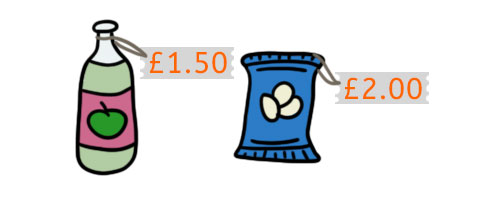
Answer: £1.50 + 2.00 = £3.50
The following problem needs more than one calculation.
Question: You buy a book for £4.50 and a pen for £1.25. You pay with a £10 note. How much change will get get?
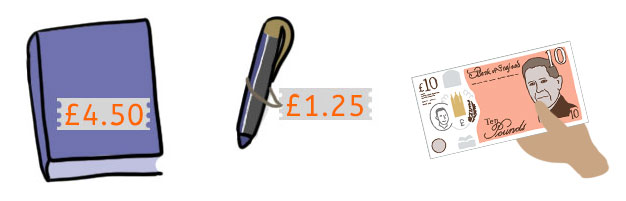
Answer:
First add the cost of the book and pen.
£4.50 + £1.25 = £5.75
Next take the amount away from £10.
£10.00 - £5.75 = £4.25
Toy Shop MoneyGive the correct change using a mixture of coins. Select Mixed coins > Give change.
Pay for itYou are the shop keeper. You have to scan the items, the customer will pay you some money and you have to give them some change.