

Angles Year 3 & 4
Angles Year 3 & 4 KS2 Maths. Learn about the types of angles, right, acute, obtuse and reflex angles. How to estimate angles wth games & worksheets.
Pick a level
What is an angle?
An angle shows how much something turns or the space between two lines.
Angles can be:
- A turn (like turning a corner)
- A corner (like the corner of a shape)


Angles do not change size if you make them bigger or smaller. This means:
- A small angle drawing and a big angle drawing can still be the same angle.
- Angles stay the same size if the image is big or small. It doesn't make a difference to the angle.
- The length of the lines in your drawing of an angle does not matter.
Only the amount of turn matters!
Angles in shapes
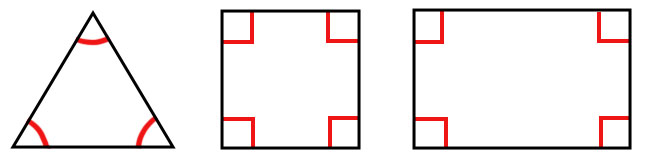
Angles are found in all shapes. For example:
- A triangle has 3 angles
- A square has 4 right angles
- A rectangle also has 4 right angles
Look carefully at shapes to find and compare their angles.

Right angles
A right angle is one of the most important angles to learn.
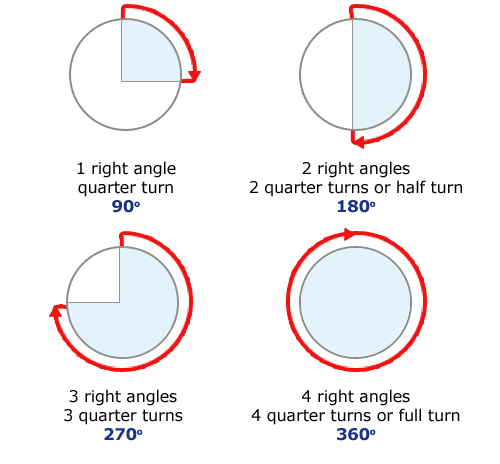
A right angle is a quarter turn, which means it is one quarter of a full circle. It is always 90° (ninety degrees).
Right angles are very common in everyday life. You can find them in:
- The corners of books
- Doors and windows
- Tables and floors
- The edges of walls and rooms
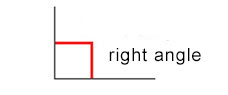
A good way to recognise a right angle is that it makes a perfect square corner.
Turns
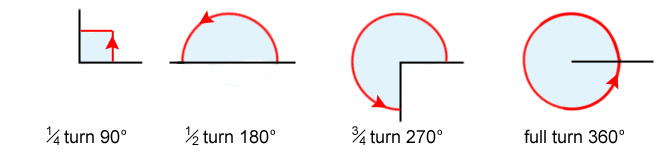
Angles are linked to turns.
- 1 right angle = quarter turn
- 2 right angles = half turn (180°)
- 3 right angles = 3 quarter turn (270°)
- 4 right angles = full turn (360°)
These facts help you understand how angles fit together.

Types of angles
There are four main types of angles to learn.
Right angles
Right angles we already know about, they are exactly 90°.
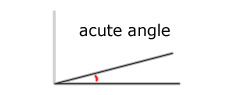
Acute angles
An acute angle is smaller than a right angle.
- It is less than 90°.
- It looks like a small, sharp corner.
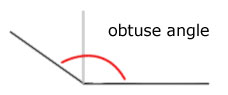
Obtuse angles
An obtuse angle is bigger than a right angle.
- It is more than 90° but less than a straight line.
- It looks like a wide or open.
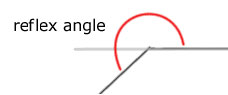
Reflex angles
A reflex angle is even bigger.
- It is more than a straight line.
- Greater than 180°.
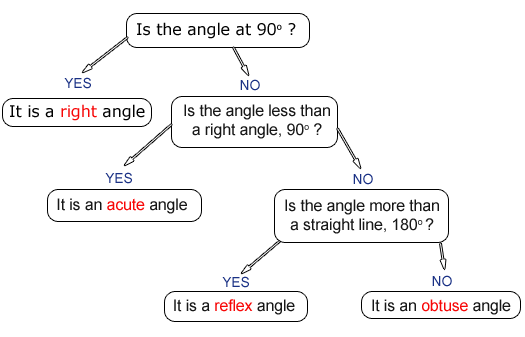
Still having problems working out what an angle is? Use this chart to help you work it out.
Find the angles in these pictures. Are they more than or less than a right angle?
Work out if these angles are right angles, acute, obtuse or reflex angles.
Estimating angles
Sometimes you don’t need to measure an angle exactly.
You can estimate it!
To estimate:
- Compare it to a right angle (90°)
- Ask: is it smaller or bigger?
For example:
- Smaller than 90° → acute
- Bigger than 90° → obtuse

Question: Estimate the angle below.

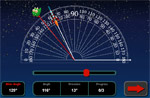
Alien AnglesYour job is to set the angle on the rescue launcher. Can you estimate the angles within 5 degrees?.
Take a look around you. Do you notice all the angles?