Multiplication Year 5 & 6

Multiplication games

Multiplication

Multiplication Year 5 & 6

Multiplication Year 5 & 6 for kids. Maths homework help for children in Key Stage 2 (KS2) Maths at Primary School. Maths homework help.

Pick a level

Times Tables

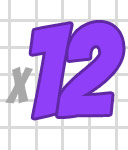
In Year 5 you should learn the 7 times tables and 12 times tables.
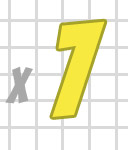
x7 x12

Multiples and factors

To tackle maths, you need to know the difference between multiples and factors:

Factors

Factors are smaller numbers that divide into a bigger number with nothing left over.

Multiples

Multiples are the numbers you land on when skip-counting in a times table.

Multiples of 5

5 10 15 20 25 30 35 40 45 50 55 60

Prime, square and cube numbers

Numbers have special properties.

Prime numbers

Prime numbers only have 2 factors. The number and 1. 5 is a prime number because only 5 and 1 divide into it equally without any remainder.

Square numbers

When you multiply a number by itself, the answer is a square number. 5 x 5 = 25. 25 is a square number.

Sometimes you will see 5². This means 5 squared, or 5 x 5. So 5² = 25.

Cube numbers

When you multiply a number by itself and then by itself again, the answer is a cube number. 2 x 2 x 2 = 8. 8 is a cube number.

Sometimes you will see 2³. This means 2 cubed, or 2 x 2 x 2. So 2³ = 8.

Multiplying by decimals by 10, 100 and 1000

When multiplying whole numbers or decimals by 10, 100, or 1000, move the digits to the left on a place value chart to make the number bigger.

Multiply by 10, move digits 1 place left.

Multiply by 100, move digits 2 places left.

Multiply by 1000, move digits 3 place left.

Multiplication games
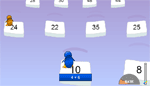
Penguin JumpPenguin jump
Answer the multiplication questions right and be the first to reach the end.

Multiplication.comMultiplication.com
Use these games to practice your times table skills.

Fun 4 the brainFun 4 the brain
Use these games to practice your multiplication skills.

Free online Maths games

Multiplying by decimals by 10, 100 and 1000

When multiplying whole numbers or decimals by 10, 100, or 1000, move the digits to the left on a place value chart to make the number bigger.

Multiply by 10, move digits 1 place left.

Multiply by 100, move digits 2 places left.

Multiply by 1000, move digits 3 place left.

Grid multiplication

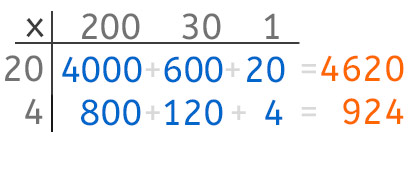
Multiplication with big numbers can be worked out with a grid.
Work out: 231 x 24

1) Break up the 231 and add it to the top. Break up the 24 and add it to the side.
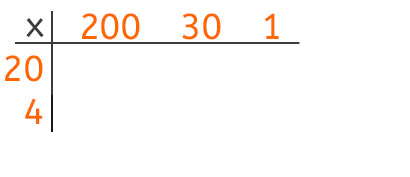
Multiplication in a grid step 1

2) Work out the sums 200 x 20, 30 x 20, 1 x 20, 200 x 4, 30 x 4, 1 x 4.
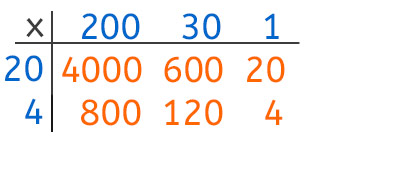
Multiplication in a grid step 2

3) Add up the rows.
Multiplication in a grid step 3

4) Add up the two totals to get the answer to 231 x 24.
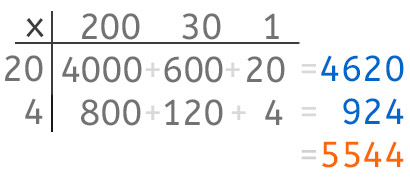
Multiplication in a grid step 4

Long multiplication

If a calculation has large numbers, (up to 4 digits) by 2-digit numbers. It is too big to do in your head so you'll need to work it out on paper with long multiplication (column method).
Work out: 32 x 14

Using BODMAS

When a maths calculation has a mixture of operations, you must solve them in a specific order:

  1. Brackets
  2. Orders (powers / square numbers)
  3. Division
  4. Multiplication
  5. Addition
  6. Subtraction

An easy way to remember this is: Bony Old Dinosaurs Make Awful Soup

(3 x 4) x 5 =

First work out the sum in the brackets.

3 x 4 = 12

Replace this in the sum where the brackets were.

12 x 5 = 60

Word problems

Word problems often have two or three steps. Drawing a bar model helps you break the question down before doing the written calculations.

Maya has £50. She buys 3 books that cost £8 each. How much money does she have left?

Draw a bar with 3 boxes of £8 to find the total spent (3 x 8 = £24).
Compare the £24 bar to the £50 total bar to find the missing change (50 - 24 = £26).

Also on Super Brainy Beans

Shapes Symmetry Times Tables Multiplication Water Cycle