Angles Year 5 & 6

Angles

Angles Year 5 & 6

Angles Year 5 & 6 Maths, KS2. Homework help with estimating angles. Learn to measure with a protractor, draw angles, and use angle rules to find missing angles with step-by-step help.

Pick a level

Degrees °

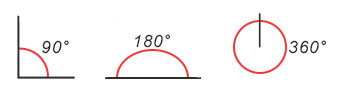
Angles are measured in degrees, written as °.

A full turn is 360°, which means:

  • Half a turn is 180°
  • A quarter turn is 90°

Degrees tell us exactly how big an angle is.

Degrees

Using a protractor

Measuring with a protractor

A protractor is a tool used to measure angles.

To measure an angle correctly:

  1. Place the centre of the protractor on the vertex (the corner of the angle)
  2. Line up one side of the angle with the zero line
  3. Read the number where the other side crosses the scale

It is important to:

  • Start from the correct 0° line
  • Read the scale in the correct direction

Watch the video below to see how to use a protractor step by step, then practise by completing the worksheet.

Angle EstimatesAngle Estimates
Practice using this online protractor to measure angles.
Measuring angles with a protractor
Have a go at measuring these angles with a protractor.

Drawing angles with a protractor

You can also use a protractor to draw angles.

To draw an angle:

  1. Draw a straight line
  2. Place the protractor at one end of the line
  3. Mark the correct number of degrees
  4. Draw a second line from the starting point to your mark

This allows you to create accurate angles such as 45°, 90°, or 120°.

Types of angles

You should now be confident with different types of angles, but here is a reminder:

Right angles

Right angles we already know about, they are exactly 90°.
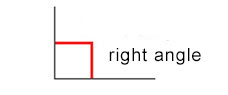
Right angle

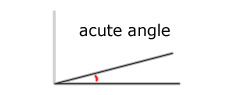
Acute angles

An acute angle is smaller than a right angle.

  • It is less than 90°.
  • It looks like a small, sharp corner.

Acute angle

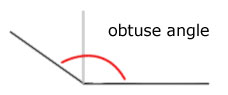
Obtuse angles

An obtuse angle is bigger than a right angle.

  • It is more than 90° but less than a straight line.
  • It looks like a wide or open.

Obtuse angle

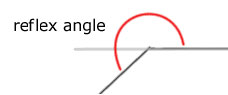
Reflex angles

A reflex angle is even bigger.

  • It is more than a straight line.
  • Greater than 180°.

Reflex angle

Angle facts

These are very important rules that you will use to solve problems.

Angles around a point

Angles around a point always add up to 360°.

This is because a full turn is 360°.

If some angles are missing, you can find them by subtracting from 360°.
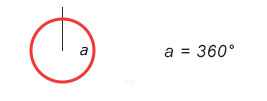
Angles on point

Angles on a straight line

Angles on a straight line always add up to 180°.

If you know one angle, you can find the other by subtracting from 180°.

This is often used when two angles are next to each other on a straight line.
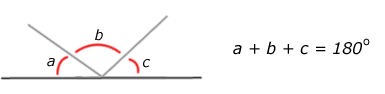
Angles on a straight line

Angles in a triangle

The angles inside any triangle always add up to 180°.

This is true for all triangles, no matter their shape or size.

Try this:

  • Draw a triangle and cut it out
  • Cut off the three corners
  • Place them together along a straight line

You will see that they form a straight line, showing that they add up to 180°.

Once you know this rule, you can find missing angles in triangles.
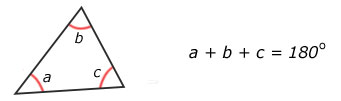
Angles in a triangle

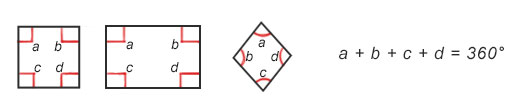
Angles in quadrilaterals

A quadrilateral is a shape with four sides. The angles in any quadrilateral add up to 360°.

This includes:

  • Squares
  • Rectangles
  • Other four-sided shapes

Quadrilateral angles

Perpendicular lines

Perpendicular lines are lines that meet at a right angle.

This means they always form a 90° angle.

You can see perpendicular lines in:

  • Corners of rooms
  • The edges of books
  • Cross shapes

Recognising perpendicular lines helps you identify right angles in diagrams and shapes.
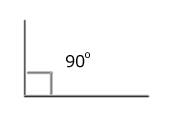
Perpendicular angles

Solving missing angle problems

You can use angle facts to work out unknown angles.

For example:

  • If two angles in a triangle are known, you can find the third
  • If angles are on a straight line, you can find the missing angle
  • If angles meet at a point, you can use the total of 360°

Always:

  • Look for known angle facts
  • Add or subtract carefully

Also on Super Brainy Beans

Shapes Symmetry Times Tables Multiplication ÔÇØWeather Christianity