Parts of a plant
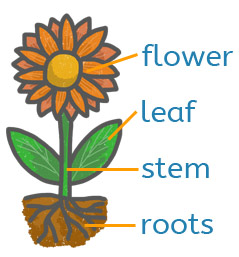
Flowering plants are living things that grow, reproduce and make their own food. Most flowering plants have four main parts: the flower, leaves, stem and roots. Each part has an important job that helps the plant survive.
Flower
The flower is the part of the plant responsible for reproduction. Some plants have one flower, while others have many.
The large, colourful parts of the flower are called petals. Petals attract insects such as bees and butterflies with their bright colours and sometimes their scent. Insects help carry pollen from one flower to another. This process is called pollination.
Inside the flower are special structures. The stamen produces pollen, which contains the male cells. In the centre is the carpel (or pistil), which contains the female parts of the flower. When pollen reaches the carpel, the plant can produce seeds.
After pollination and fertilisation, many flowers develop into fruit, which protects the seeds inside.
Leaf
Leaves are the plant’s food factories. Most plants have many leaves to help them make enough food.
Leaves use sunlight, water and a gas from the air called carbon dioxide to make food. This process is called photosynthesis. The green colour in leaves comes from a substance called chlorophyll, which helps capture sunlight.
The food made in the leaves gives the plant energy to grow, repair itself and produce flowers and seeds.
Leaves also help with gas exchange, taking in carbon dioxide and releasing oxygen. This oxygen is essential for humans and animals to breathe.
Stem
The stem supports the plant by holding up the leaves and flowers so they can reach sunlight.
Inside the stem are tiny tubes that transport substances around the plant. These tubes carry:
- Water and minerals from the roots to the leaves
- Food (sugars) from the leaves to the rest of the plant
Without the stem, the plant would not be able to move water and nutrients where they are needed.
In trees, the stem is called a trunk. Tree trunks are covered in bark, which protects the tree. Unlike many green plant stems, tree trunks are usually brown and woody.
Roots
The roots grow underground and anchor the plant firmly in the soil. This stops it from being blown away by wind.
Roots absorb water and minerals from the soil. These minerals are important for healthy growth. The water travels up through the stem to the leaves, where it is used in photosynthesis.
Some plants store food in their roots. For example, carrots and beetroot are swollen roots that store energy for the plant.
Each part of a plant has a specific role, but they all depend on one another. The roots absorb water, the stem transports it, the leaves make food, and the flower produces seeds for new plants.
If one part does not function properly, the whole plant can struggle to survive. This shows how living things are made up of systems that work together.
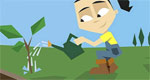 BBC Bitesize - What are the parts of a plant?
Plants have roots, stems and leaves. Some also have flowers.


What does a plant need to grow?
Plants need food to grow, but they do not eat like animals do. Instead, they make their own food in their leaves. This process is called photosynthesis.
To make food, plants need a few important things.
- Plants need light from the Sun. Light gives the plant energy to make food. This happens mainly in the leaves, which are usually green.
- Plants also need air. They use a gas from the air called carbon dioxide to help make their food.
- They need water, which is taken in by the roots from the soil. The water travels up the stem to the leaves.
- Plants also need nutrients (minerals) from the soil. These help them grow strong and healthy. If a plant does not get enough nutrients, it may look small or yellow.
- Plants also need space. If too many plants grow close together, they compete for light, water and nutrients. Bigger plants may block sunlight from smaller ones.
Different plants need different amounts of these things. For example, a cactus can live in hot, dry places and does not need much water. Other plants, like ferns, need lots of water and shade to grow well.
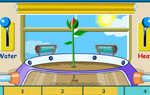 Growing a plant
Learn about how plants grow by experimenting with different conditions. Using heat & water, see if you can make the plant grow to a healthy size.
BBC Bitesize - What does a plant need to grow?Plants provide food for people and animals to eat. They also make oxygen. All people and animals need oxygen to breathe.
How water moves through plants
Plants need water to stay healthy and make food. Water is absorbed from the soil by the roots. Tiny root hairs help soak up as much water as possible.
Once inside the plant, the water travels up the stem through very small tubes. These tubes carry the water all the way to the leaves, where it is used to help make food. This movement of water through the plant is called transport.
Without water:
- Leaves may droop or wilt
- The plant cannot make enough food
- Growth slows down
Water also helps keep the plant firm and upright.
Flower colouring
- Fill a clear cup with water.
- Add a few drops of food colouring.
- Place a white flower (like a carnation) or a celery stick into the water.
- Leave it for a day or two.
You may notice the petals or leaves change colour. This shows that the coloured water has travelled up through the stem to the rest of the plant.
 Plants for kids
Learn about the fascinating world of plants for kids with our range of fun experiments & free games.

Grouping living things
Scientists group living things to help them understand and study them. This is called classification. Grouping makes it easier to spot similarities and differences between organisms.
One important way to group animals is by whether they have a backbone.
Vertebrates and invertebrates
Animals that have a backbone are called vertebrates. Their backbone supports their body and protects the spinal cord. Vertebrates include:
- Mammals (such as dogs and humans)
- Birds
- Fish
- Reptiles
- Amphibians
Animals without a backbone are called invertebrates. Most animals on Earth are invertebrates. Examples include insects, spiders, worms and snails.
Using classification keys
Scientists often use a classification key to identify living things. A simple key might ask a series of yes/no questions such as:
- Does it have wings?
- Does it have six legs?
- Does it live in water?
By answering each question, you can narrow down what the organism is.
Classification keys help scientists:
- Identify unknown species
- Organise information clearly
- Compare living things
They are like a flowchart that guides you step by step.
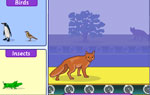 Plant & Animal Differences
Learn the differences between animals & plants, sort them into different categories and discover more about birds, mammals, insects & plants.
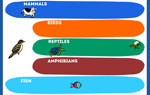 Animal classification
Can you put all the animals in the right classification groups?
Food chains and food webs
All living things need energy to survive. Energy in most ecosystems begins with the Sun.
Plants use sunlight to make their own food. Animals cannot make their own food, so they must eat plants or other animals.
Producers and consumers
Plants are called producers because they produce their own food.
Animals are called consumers because they consume (eat) other living things.
There are different types of consumers:
- Herbivores eat plants.
- Carnivores eat other animals.
- Omnivores eat both plants and animals.
Predators and prey
A predator is an animal that hunts and eats other animals. The animal that is hunted is called the prey. For example, a fox is a predator, and a rabbit may be its prey.
Predators and prey help keep populations balanced in an ecosystem.
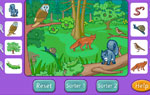 Food chains
Learn about various living things such as animals and plants, sort them into different categories and discover where they fit into the food chain.
 Food chain game
Drag the parts of the food chain to their correct place. When the chain is complete it will come to life and you can watch the food chain in action.
Also on Super Brainy Beans