Plants & Animals
Year 5 & 6
Plants & Animals for kids in Year 5 & 6. Learning KS2 Science at Primary School. Learn about plant reproduction, life cycles, adaptation and evolution.
Pick a level
Plant reproduction
Plants reproduce (make new plants) in two main ways: sexual reproduction and asexual reproduction.
Sexual reproduction
Sexual reproduction happens in flowering plants. It involves two main stages: pollination and fertilisation.
Pollination occurs when pollen is transferred from the male part of a flower (the stamen) to the female part (the carpel or pistil). This can happen through insects, wind or sometimes water.
After pollination, fertilisation takes place. The pollen joins with an ovule inside the flower. This allows a seed to form. Many plants also develop fruit, which protects the seeds and helps with dispersal.
Sexual reproduction produces variation, meaning the new plants are slightly different from their parents. This variation can help species survive changes in the environment.
Asexual Reproduction
Asexual reproduction does not require pollination or seeds. Instead, a new plant grows from part of the parent plant. The new plant is genetically identical to the parent.
Common examples include:
- Bulbs – Plants such as onions and tulips grow from underground bulbs that can produce new plants.
- Runners – Strawberry plants send out thin stems (runners) that grow new plants along the ground.
- Cuttings – Gardeners can cut a piece of stem from a plant and grow a new one from it.
Asexual reproduction allows plants to spread quickly, especially in stable environments.
Life cycles of plants
All plants go through a life cycle, which shows the stages of growth and reproduction.
Germination
The life cycle begins with a seed. When a seed has the right conditions — water, warmth and oxygen — it begins to grow. This process is called germination.
The seed absorbs water, swells and splits open. A tiny root grows downward into the soil, and a shoot grows upward toward the light.
Growth
As the plant grows, it develops roots, stems and leaves. The leaves begin making food through photosynthesis, allowing the plant to grow bigger and stronger.
Flowering
When the plant is mature, it produces flowers. Flowers are important for reproduction because they contain the reproductive organs.
Seed Production
After pollination and fertilisation, seeds form. These seeds can be dispersed by wind, animals or water, allowing new plants to grow in different places.
The cycle then begins again.
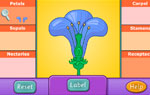 Dissect a plant
Learn about life cycles by sorting the parts of a flower, discovering what each part does and how in contributes to the life cycle of a living thing.
 BBC Bitesize - What is the lifecycle of a plant?
Seeds grow roots and shoots. Roots and shoots then grow leaves above ground.
Plant adaptations
Plants are adapted to survive in different environments. An adaptation is a feature that helps a living thing survive in its habitat.
Desert plants
Desert plants, such as cacti, are adapted to survive in hot, dry conditions. They often have:
- Thick stems to store water
- Spines instead of leaves to reduce water loss
- Wide root systems to quickly absorb rainfall
Some desert plants can survive long periods without rain.
Rainforest plants
Rainforest plants grow in warm, wet environments where there is a lot of competition for sunlight. Many have:
- Large leaves to absorb as much light as possible
- Drip tips to allow rainwater to run off
- Shallow roots to absorb nutrients from the top layer of soil
Some rainforest plants grow on other trees to reach the sunlight.
Aquatic plants
Aquatic plants live in water. They are adapted in different ways depending on whether they float or grow underwater.
Floating plants often have:
- Broad leaves that float on the surface
- Air spaces inside their stems for buoyancy
Underwater plants may have flexible stems to move with water currents.
Why adaptations matter
Adaptations help plants survive in challenging conditions. Without these specialised features, many plants would not be able to live in such extreme environments.

Life cycles of animals
Animals are living organisms that grow, reproduce and respond to their environment. Unlike plants, animals cannot make their own food, so they must eat other organisms to get energy.
A life cycle shows the stages a living thing goes through from birth to adulthood and reproduction. Different groups of animals have different life cycles.
Mammal life cycle
Mammals (such as humans, dogs and whales) give birth to live young. The babies grow inside the mother before they are born.
Mammal life cycle:
- Born live
- Grow and develop
- Become adults
- Reproduce
Mammal babies feed on their mother’s milk when they are young. They often need care and protection for a long time.
Amphibian life cycle
Amphibians, such as frogs and toads, usually lay eggs in water.
A frog’s life cycle includes:
- Egg
- Tadpole (with gills and a tail)
- Froglet (developing legs)
- Adult frog
This process of changing body form is called metamorphosis. Amphibians often live part of their life in water and part on land.
Bird life cycle
Birds lay eggs with hard shells. The eggs are usually kept warm by the parents until they hatch.
Bird life cycle:
- Egg
- Chick
- Young bird
- Adult
Young birds grow feathers and learn to fly before becoming fully independent.
Insect life cycle
Many insects go through metamorphosis, but there are two types.
Some insects, like grasshoppers, go through incomplete metamorphosis:
- Egg
- Nymph (small version of adult)
- Adult
Others, like butterflies, go through complete metamorphosis:
- Egg
- Larva (caterpillar)
- Pupa (chrysalis)
- Adult
Complete metamorphosis involves a dramatic change in body shape.
 BBC Bitesize - Lifecycles
Learn about the different stages of an animal's life.
Reproduction in animals
Reproduction is the process by which animals produce offspring (young).
Most animals reproduce sexually, meaning they have two parents. The offspring inherit characteristics from both parents.
Offspring are usually similar to their parents, but they are not identical (unless they are identical twins). This is because each parent passes on different genetic information.
For example:
- A puppy may have the same fur colour as one parent but the ear shape of the other.
- Human children may share eye colour with one parent and hair type with the other.
This mixing of characteristics is called variation.
Variation within a species
Variation means the differences between individuals of the same species.
Even within one species:
- Some individuals may be taller or shorter
- Some may have different colouring
- Some may be stronger or faster
Variation is important because it helps species survive. If the environment changes, some individuals may have characteristics that help them adapt more successfully.
Evolution & inheritance
Living things have not always looked the way they do today. Over millions of years, species have changed. The study of how living things change over time is called evolution.
Evolution happens very slowly, across many generations.
Fossils and evidence of the past
Fossils are the preserved remains or traces of ancient living things. They can include bones, teeth, shells, footprints or even imprints of plants.
Most fossils form when a plant or animal dies and is quickly covered by mud or sand. Over time, layers build up and the remains slowly turn to rock.
Fossils are important because they give us evidence about what lived on Earth long ago. They show that many species that once existed are now extinct, and they also show that some species have changed over time.
For example, fossils reveal that some ancient sea creatures lived in places that are now dry land. This tells scientists that Earth’s environments have changed dramatically over millions of years.
Fossil discoveries helped scientists understand that life on Earth has a long history stretching back billions of years.
Inheritance and variation
Inheritance is when characteristics are passed from parents to their offspring.
These characteristics might include:
- Eye colour
- Hair type
- Height
- Certain behaviours
Offspring inherit information from both parents, which is why they are similar to them. However, they are not identical (unless they are identical twins). The differences between individuals of the same species are called variation.
Variation can be caused by:
- Differences in inherited genes
- Environmental factors, such as diet or climate
Variation is important because it means that not all individuals are the same. Some may be better suited to survive in certain conditions than others.
Inheritance and variation
Inheritance is when characteristics are passed from parents to their offspring.
These characteristics might include:
- Eye colour
- Hair type
- Height
- Certain behaviours
Offspring inherit information from both parents, which is why they are similar to them. However, they are not identical (unless they are identical twins). The differences between individuals of the same species are called variation.
Variation can be caused by:
- Differences in inherited genes
- Environmental factors, such as diet or climate
Variation is important because it means that not all individuals are the same. Some may be better suited to survive in certain conditions than others.
How adaptation can lead to evolution
An adaptation is a characteristic that helps an organism survive in its environment.
For example, animals living in cold climates may have thick fur. Plants in dry areas may store water in their stems.
If a helpful adaptation increases an organism’s chance of surviving and reproducing, it is more likely to be passed on to the next generation. Over many generations, this adaptation can become common within the species.
This gradual change over a very long time is called evolution.
Evolution does not happen in a single lifetime. It occurs over thousands or millions of years as small changes build up.
Biodiversity
Biodiversity means the variety of living things in a particular area. This includes:
- Different species of plants
- Different species of animals
- Different habitats
An area with high biodiversity has many different species living together. These ecosystems are often stronger and more stable because living things depend on one another in food webs and habitats.
When species disappear, ecosystems can become unbalanced. For example, if a predator disappears, prey populations may grow too large. If pollinators decline, fewer plants may reproduce.
Protecting biodiversity helps maintain healthy ecosystems that provide clean air, clean water and food.
Also on Super Brainy Beans