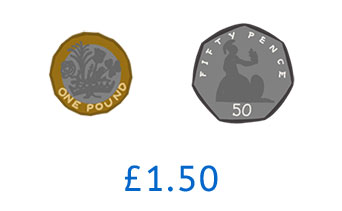
£1.50 means 1 pound and 50 pence.
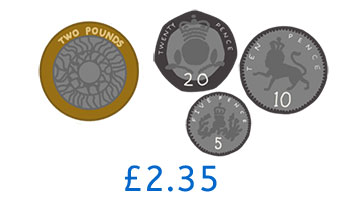
£2.35 means 2 pounds and 35 pence.
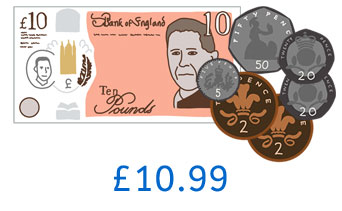
£10.99 means 10 pounds and 99 pence.
Imagine you buy:
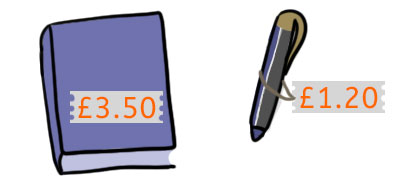
To find the total cost, add the prices together.

Add money is a useful skill whenever you buy more than one item.
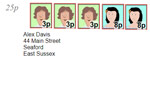 Stamp Sticking
Drag the stamps onto the envelopes to make the exact postage as shown at the top left of each envelope.
Calculating change
If you know how much an item costs and how much money was given, you can work out the change.
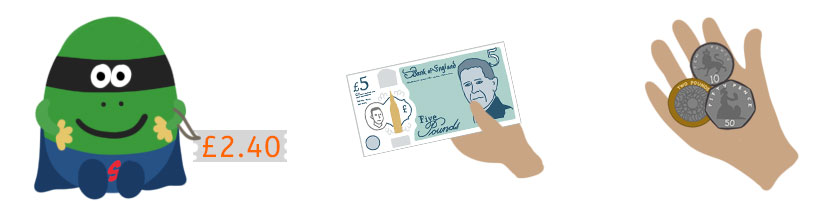
A toy costs £2.40. You pay with £5.00. £5.00 − £2.40 = £2.60. The change is £2.60.
 Space Shoppers
The Space Shoppers are cosmic aliens who have landed at the Money Funfair on Earth. They need your help to learn how humans use money..
Solving money problems
Money problems help you use maths in real-life situations.
Question: A drink costs £1.50 and a snack costs £2.00. How much do they cost altogether?
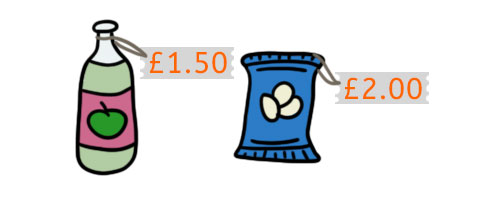
Answer: £1.50 + 2.00 = £3.50
The following problem needs more than one calculation.
Question: You buy a book for £4.50 and a pen for £1.25. You pay with a £10 note. How much change will get get?
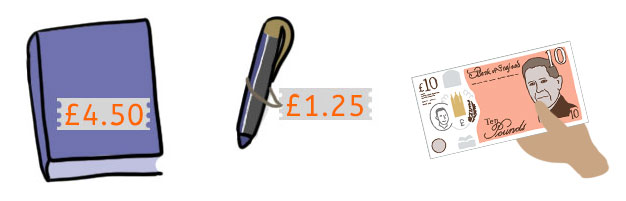
Answer:
First add the cost of the book and pen.
£4.50 + £1.25 = £5.75
Next take the amount away from £10.
£10.00 - £5.75 = £4.25
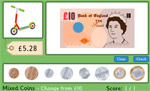 Toy Shop Money
Give the correct change using a mixture of coins. Select Mixed coins > Give change.
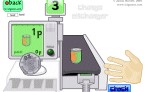 Pay for it
You are the shop keeper. You have to scan the items, the customer will pay you some money and you have to give them some change.

Also on Super Brainy Beans